
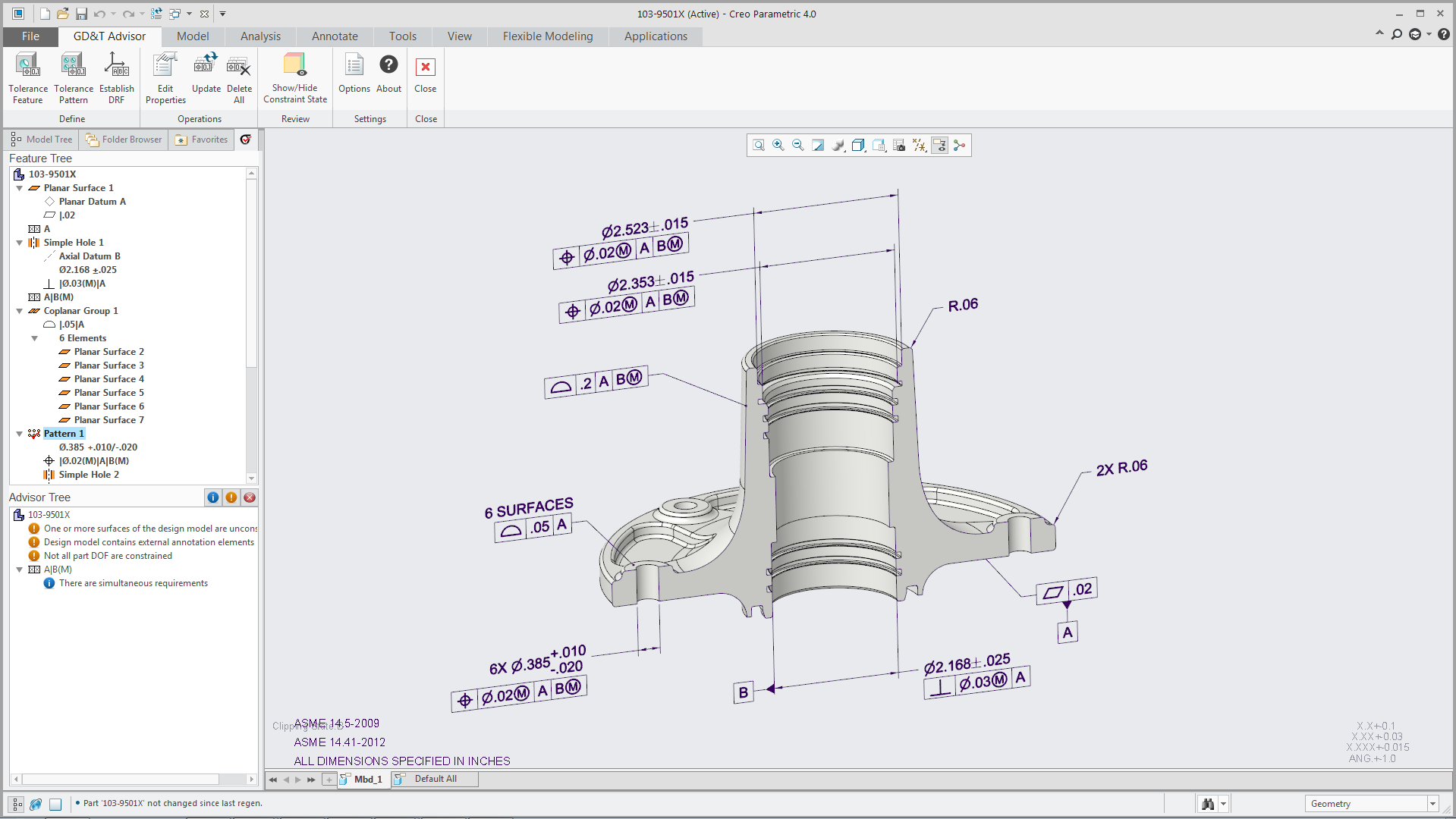
With the C-suite increasingly onboard with model-based definition (MBD) and the value it delivers to downstream manufacturing and service processes, attention needs to turn to engineering and product development, which is still hampered by disconnected processes and siloed tools. Faced with mounting global competition, increasing product complexity, and a mandate to accelerate delivery cycles, organizations are taking every opportunity to optimize design and manufacturing processes. MBD has gained traction as a key step in that direction, replacing the traditional 2D drawings used in upstream processes with annotated 3D models that contain all the pertinent information required to manufacture and inspect a product, including elements like dimensions, tolerances, surface finishes, and notes. The model-based enterprise (MBE) builds on that vision to extend MBD even further into manufacturing, supply chain, marketing, and other disciplines, aiming for across-the-board organizational benefits such as process efficiencies, lower overall costs, and faster time-to-market. Yet there remains a missed opportunity to achieve that full MBE vision. Engineering, despite championing 3D models for MBD processes, has yet to embrace a comparable model-centric design mentality in its own house, across the full spectrum of product development processes. Outside of core CAD modeling and design work, it’s been open season for engineers to tap best-of-breed tools for adjunct functionality in key areas like simulation, generative design, surfacing, tool path creation, and documentation. What’s needed is a Model-Based Product Development approach, which promotes a unified platform and a common CAD model across the core set of tools and functionalities required throughout the engineering lifecycle.
Key Terminologies
Model-Based Definition (MBD) is “an annotated model and its associated data elements that define the product in a manner that can be used effectively without a drawing graphic sheet”. (ASME Y14.47-2019 3.1)
Model-Based Product Development (MBPD) is the process of using the native CAD model throughout the entire product development cycle. Beginning with concept development, including industrial design, ranging all the way through detailed design, simulation, tooling development, manufacturing process development and service instructions, the native CAD model drives the digital thread through the entire product development lifecycle.
Model-Based Enterprise (MBE) is “an organization that uses model-based definitions for the purpose of commission, operation, service and decommission of a product.” (ASME Y14.47-2019 3.11)
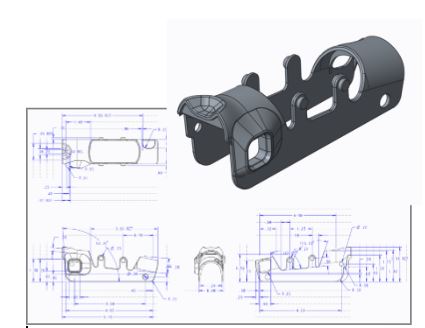
Model-Based Product Development Takes Shape When you consider the big picture, Model-Based Product Development is crucial to advancing the vision and goals of the digital thread and MBE, now at the forefront of forward-looking business strategy. The approach takes shape through a series of interconnected design, optimization, and build processes coalescing around a common, native CAD model instead of derivative artifacts that aren’t tied to the core design. With all contributors working from a unified 3D model, organizations have the best chance of driving efficiencies throughout the design process and eventually, across a product’s full lifecycle.Just look at how MBD’s focus on a unified 3D model has made it easier to share relevant information and collaborate across design, production, and service functions. MBD has had a measurable impact on product delivery workflows, streamlining what was once an onerous process of managing 2D drawings and shortening the time spent in design reviews. PTC’s customer research shows a robust MBD approach enables companies to produce documentation up to 40% faster, reduce first article inspection time by 60%, and benefit from a 90% drop in product errors and non-conformances. Engineers require a robust tool bench to build today’s competitive products. However, a best-of-breed portfolio doesn’t typically share a native file format, which creates all sorts of complications and integration problems when aiming for a universal, annotated 3D model. It also makes it next to impossible to drive comparable efficiencies along the lines of MBD. Without a common backbone to work from, product organizations find themselves subsumed by disconnected processes and manual workarounds—the tell-tale signs of a landscape dominated by siloed tools and disparate file formats. Engineers wind up channeling too much time and energy to context switching between applications, which takes away from higher-value experimentation and design innovation. Without a model that transcends the full design tool stack, they are bogged down by translation and integration tasks, caught in a continuous cycle of unproductive rework that can lead to serious and costly design errors.The promise of 3D CAD, and specifically parametric modeling, is that design intent is easily captured using features and constraints, which makes it easier to define how the model should behave when something is changed. Moreover, best-in-class parametric modeling is deeply associative so that when changes occur in one part of a model, the relevant updates are automatically orchestrated to related geometry and downstream artifacts, keeping every point in the design chain in sync, eliminating mundane rework, and minimizing the possibility of design errors.
The vision starts to fall apart, however, when point solutions are introduced for enhanced capabilities beyond core CAD modeling. For example, simulation is gaining traction early on in the development cycle to ideate, optimize, and narrow the design space as opposed to being a latter-stage tool used by a select few for validation. Similarly, design teams are now enthusiastically embracing an array of powerful capabilities for generative design, rendering, augmented reality (AR), and tool path creation to uplevel their innovations and streamline processes, all furthering the quest to get better products to market faster. The problem is most of those auxiliary functions are happening outside of the main CAD environment, thus are not directly associative with the native 3D model. In most cases, if an engineer wants to run a FEA analysis on a part to test strength or to lightweight a particular component using generative design capabilities, they must toggle between point solution tools. This work pattern introduces a cycle of importing, exporting, and translating dumb geometry, which is not only inefficient, but it also breaks the tool chain and decreases the inherent benefits of associative parametric design.By context switching between applications, engineering organizations effectively create a series of disconnected processes that lack associativity. Instead of letting the native CAD model do the work, the onus falls to the designer or engineer to propagate changes throughout the design chain. It’s tedious work, and a colossal waste of engineering time and resources.Consider this reality in the context of creating an NC tool path. A manufacturing engineer sets up a study in a point solution to create the tool path, but realizes there’s a problem. Because this function isn’t done with a native CAD file, the process requires someone to go back to the original CAD model, make the pertinent changes, and restart the process, importing and exporting geometries and recreating the tool path design from scratch. The same workflow, performed inside the CAD tool on a native CAD file, initiates a change and everything automatically updates, allowing the new tool path design to run without any additional setup or import steps. This same process applies to simulation or rendering or writing assembly instructions. The takeaway is that engineering processes CAN and SHOULD reap the same benefits of a model-based approach that other areas of the organization now enjoy with MBD.Need more information?
